
Where's Our Breaking Point?
How much worse does it have to get before we change how we act?

On an idyllic summer morning, with mist rising from the glassy surface of the lake and the sun peeking over the trees and the haunting calls of loons nearby, I sat on my parents’ dock, with a coffee and book in hand, and cried.
I had spent the past hour immersed in Freya India’s new book, Girls: Generation Z and the Commodification of Everything, reading specifically the chapter titled “Documented,” about the disturbing compulsion to photograph, film, and share every detail of our lives online, even the most personal and intimate moments, as well as those that do not belong to us, like the lives of our children.
The horror of the practice—both the sacrificial offering up of those moments by “content creators” and the ravenous consumption of them by viewers—hit me like a gut punch. It felt revolting and nauseating. I finished the chapter, put down the book, looked around at the picture-perfect lake, and wept. What have we done? I thought. What is wrong with us?
In that moment, I mourned the young women and men who wasted so many irreplaceable years editing and posting themselves for a merciless internet audience, who grew up basing their self-worth on contrived metrics such as likes, views, and comments.
I grieved for the children whose parents systematically destroyed their privacy by posting every detail about their lives online, whether it was in the fleeting pursuit of fame, status, sponsorship deals, or revenue, or merely out of boredom and cluelessness about what was being surrendered. What a betrayal.
My sorrow extended to the millions of voyeurs who consume such content and drive demand for it. I felt a mix of pity and rage that so many people clearly have nothing better to do than scroll online and are thus complicit in its creation.
The Things I Hear
I suspect that my strong emotional reaction was triggered not just by India’s book, but also by the ever-accumulating weight of the heartbreaking stories I collect in my line of work. As a writer, public speaker, and even as a mother, people tell me a lot of sad, shocking things. Sometimes they want advice, other times just a listening ear; I try my best to respond appropriately. These stories stay with me. Often, they’re an incentive to keep fighting what feels like an upward battle at times, but lately, they’ve been making me angry.
Here are a few recent examples. Brace yourselves.
A child was severely burned in a school hallway when some kids thought it would be funny to douse him in gasoline, light him on fire, and film it.
I was brought in to give a series of talks to both students and parents in this school district about why and how to get off our phones. At one of those talks, I met some parents who told me that their 14-year-old had attempted suicide several months before. Prior to the attempt, she had withdrawn from the family, spending long hours on her phone, not seeing friends, and not playing sports anymore. She was failing academically.
The mother and father wanted my advice on what to do about her phone—besides taking it away. “We can’t do that,” they said, “because she might try again if we do.”
I was at a loss for words, floored by the fact that they felt they couldn’t get rid of the very thing that had almost stolen their daughter’s life. Why this self-imposed helplessness? I encouraged them to rethink that. I recommended Dr. Victoria Dunckley’s book, Reset Your Brain, as a source for dealing with extreme cases of screen addiction, even in situations with high risk of self-harm. But I came away feeling profoundly discouraged.
Here’s another awful story.
A boy in middle school was raped during a sleepover. It was filmed, and the video made its way around the school. The school administrators did their best to punish the perpetrators and deal with the fallout, but the boy ultimately had to change schools.
I was hired to give a talk to parents about why letting our kids have unfettered access to smartphones and the internet is a bad thing. “The parents just don’t get it,” the school principal told me. “It was weird. In dealing with this whole awful situation, it was like no one could put themselves in the boy’s shoes. It was as if everyone ceased to see him as human; he was just someone online, having this horrible thing done to him, not their own peer or friend or child. The level of dissociation was disturbing.”
So, I went there—and four people showed up. The principal was embarrassed and apologetic. I didn’t mind, because I had other talks booked in the same region, plus if my message helps four people, that’s still a worthwhile event. I just felt bad for the principal, who was trying so hard to shake parents out of an apathetic state, but was unsuccessful.
Ready for another?
Two kids in my son’s grade 9 class got in trouble for looking at child porn on one phone and filming it with another. The video travelled like wildfire around the school, one of the kids got beat up, and both found themselves at the centre of an intense investigation, which involved not just police but a great deal of social fallout (understandably so).
I don’t know how the situation was ultimately resolved, but I do know that no one seemed to be asking the biggest question I had, which was, why do kids have access to devices in their pockets that allow them to look up child porn (or anything else, for that matter) during class? And guess what? Nothing changed. All the kids will go back to school in September under the exact same feeble phone policy.
Want a final example? This is from a random conversation I had yesterday with my youngest son in the car.
Him: “I don’t like my friend’s sister’s boyfriend.”
Me: “Why not?”
“He’s a horrible person.”
“How so?”
“He beat up a kid at school.”
“What?”
“Yeah, but that kid was taking pictures of little girls at recess and sending them to men on the internet, so I kind of get it.”
“WHAT?!”
Of course, this last example is an unverified anecdote from an elementary-aged child, but again, it came as a shock. My mind was reeling. How is it that kids are allowed to wield cameras on school property? It’s totally inappropriate.
Again, what is happening? What is wrong with us? What have we done to the children?
Where Are the Adults?
These anecdotes might appear disconnected, but there is a common thread running through all of them, which is the complete abdication of responsibility on the part of the adults who should be in charge. When adults fail to protect children adequately throughout the most vulnerable years of their lives, the children suffer. This is a form of neglect.
I am sick and tired of adults pretending to be helpless, of throwing up their hands and saying ridiculous things like, “There’s nothing I can do! It’s too late! My child will be upset! Everyone else is doing it! You can’t put the genie back in the bottle!” You are the parent, and protecting your child is your most important job. Figure it out. You must do it, even when it’s difficult and uncomfortable and makes you unpopular with your child. (Also, it’s not a genie. It’s a phone. Much easier to wrangle.)
Obviously, it would be great to have support. If governments brought in digital age gating, and if social media companies were held accountable by lawsuits and forced to redesign their products to be less addictive, and if schools banned personal smartphones from their premises, and if people started sending their kids outside to play again, and if Canadian telecom companies started offering good alternatives to smartphones—if all of these things happened, then it would be far easier to refuse to let the internet ravage our children’s fleeting years of innocence.
But tragically—appallingly—that is not our reality.
Which means that we, the parents, have to start acting differently. We are the ones whose choices and actions have the most immediate and direct effect on our children’s well-being. And if there’s one thing we know as parents, it’s that the days are long, but the years are short, and we cannot wait around any longer for other people or entities or institutions to make the changes that we ourselves feel too hesitant or scared to make.
As I read through Freya India’s numerous examples of parents who have traded their children’s autonomy for YouTube views, combined with my own mental list of recently acquired horror stories, I kept thinking, where’s our societal breaking point? How bad do things need to get before we start behaving differently? In all seriousness, have we not reached rock bottom when young girls are convinced their lives aren’t worth living anymore, when sexual violence is weekend entertainment, when burning each other is done for laughs?
Surely, it cannot get worse than this. Surely, at any moment now, we will awaken from our stupor and see the effect of the phone-based childhood for what it is—an outrage, a violation, an act of desecration against the most vulnerable and innocent members of our society. We will realize what we’ve done, and reach for them, pull them back in, fold them into our arms, and whisper, “You’re safe now. I am so sorry. I’m here now, and I will never let anything like that ever happen to you again.”
What if we can’t reach them? What if they’re floating past our reach, or even out of sight? Then we go plunging into the metaphorical woods to look for them. We search until we are scratched and bug-bitten and utterly exhausted and our throats are hoarse from screaming their names. Some, we might never find. Many, we will.
And then we will be like the mother I once met, whose two teenage daughters spent 48 hours lost in the Canadian wilderness before they were found by a search-and-rescue team.
“What did you do when they were brought back to the campground?” I asked her two years later, over a bottle of wine.
She shrugged. “We ignored the TV crews and crawled back into our tent, the three of us, and we held each other for two days.”
That is what our children need. They’re lost in the dark woods. They’re groping for a firm, steady hand. They need to be rescued, brought to safety, stabilized, held tightly in a cozy tent by parents who will never let them go. No one else is coming to save them from their phones. That job is ours alone. And if we don’t do it, we will fail them.
You Might Also Like:
New Book Coming!
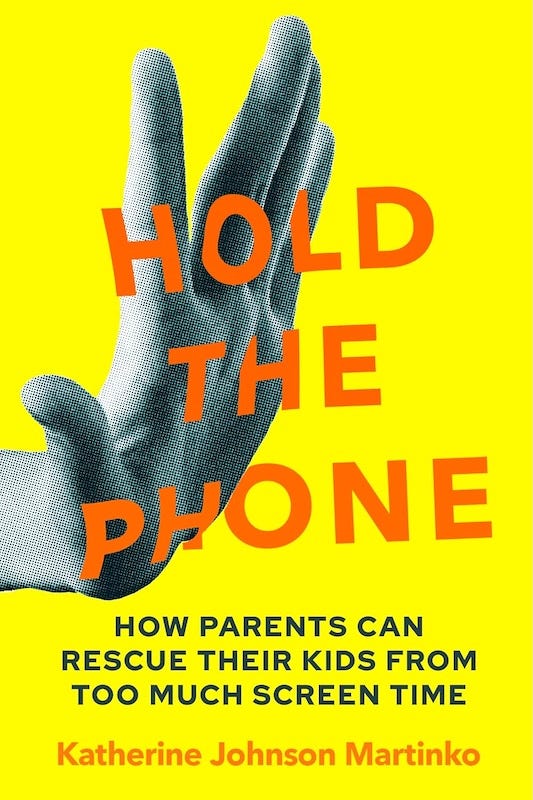
I am excited to announce that my next book, Hold the Phone: How Parents Can Rescue Their Kids From Too Much Screen Time, will be out in November, but it’s already available for preorder from Amazon. Preorders are a great way for the book industry to gauge interest in a title and to generate some hype, so please, if you’re intending to buy my book, consider ordering it in advance!
This is going to sound dramatic, but it’s almost starting to feel to me like we need to pursue a “Benedict option” (but for digital tech, not Judeo-Christian conservatism).
That’s the term coined by Christian conservative Rod Dreher in 2013 (though the concept had been floating around for decades before that) that society can’t be saved from secularism, that it’s time for a new monasticism like that of St Benedict, withdrawing into insulated communities to keep the light alive.
There’s a clear analogy to the digital situation.
I see mainstream society enthusiastically embracing AI and going ever deeper into a digital futurism where all social interactions are online; the parents aren’t trying to keep their kids out of it because they themselves are deepening into it every month. I struggle with this myself. (I can’t even do my job without using AI these days, Microsoft is forcing it incredibly aggressively down the throats of everyone who uses a Windows computer or office software for their job.) Within a couple years, teenage boys will have infinite AI-generated porn on demand on their devices. (hell, they already had it for a few months at the end of last year when Musk let xAI/Grok go wild for a few months)
At what point do people who want to raise their kids in a human environment, not a digital environment, need to withdraw into purposeful communities built around that vision?
(Aside: I think the parallel to religious communities is not just a superficial one: religion is one of the few things that makes people truly commit to a cause for multiple decades and make meaningful sacrifice to stay true to it. I think this is why Jonathan Haidt’s blog has become so religious lately. He has the same despair our host here does, and sees intentional Jewish communities as the only lasting solution for him.)
Edit: not to mention Freya India herself, who I believed moved to the U.S. last year and is becoming part of the reactionary Catholic / JD-Vance-aligned scene? I stopped following her substack so I don’t know the latest. But it felt to me in 2024-2025 that she also was seeing religion as the only antidote powerful enough for digital poison.
Thanks for what you do. These stories are really hard to read.
I have a 10-year old and it’s so tricky as we start to navigate independence. We got him a smart watch so we can easily get in touch bc he loves to ride his bike around town and to his friends homes independently. But because an Apple Watch has to be backed by an iPhone, it didn’t take long for friends to get his number and it turn into wanting the phone a lot. Now something we’re having to walk back. Someone gifted him a TinCan phone recently, so we’re trying to have him start using that instead.
We also had to take away YouTube recently. What turned into a curiosity and watching videos on specifics topics (like fishing) easily turns into a brain-rot tv watching session.